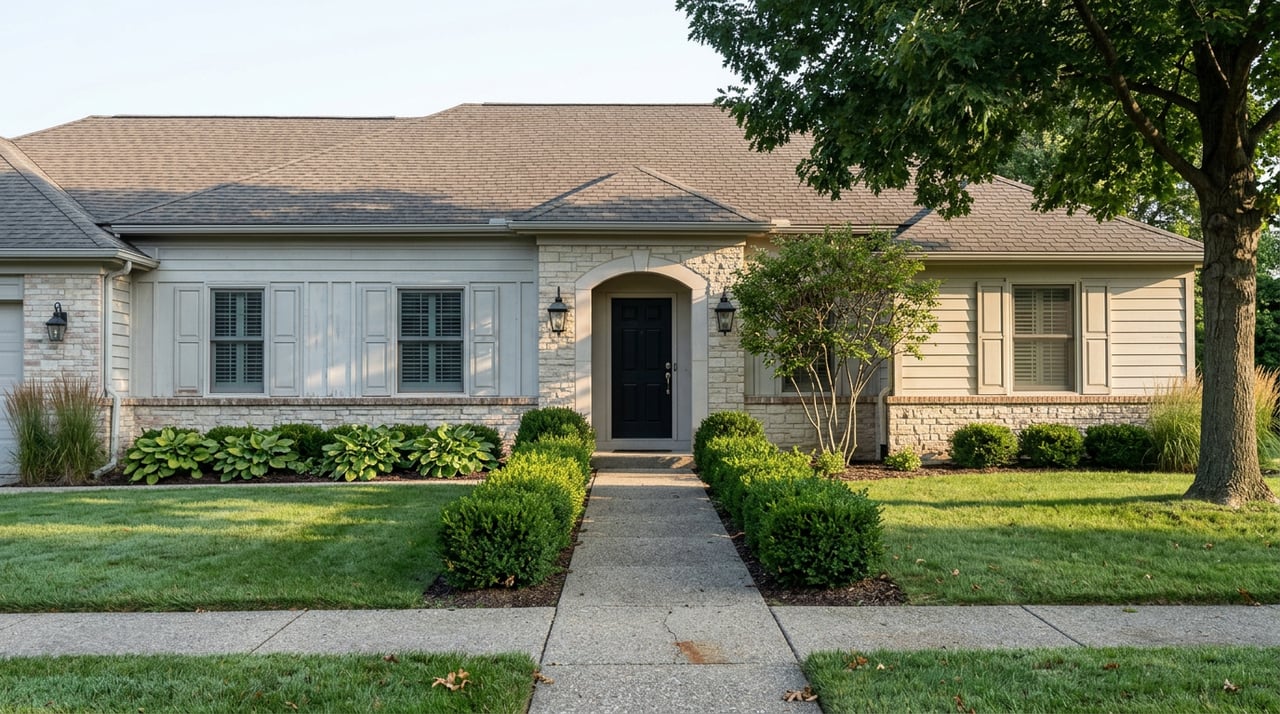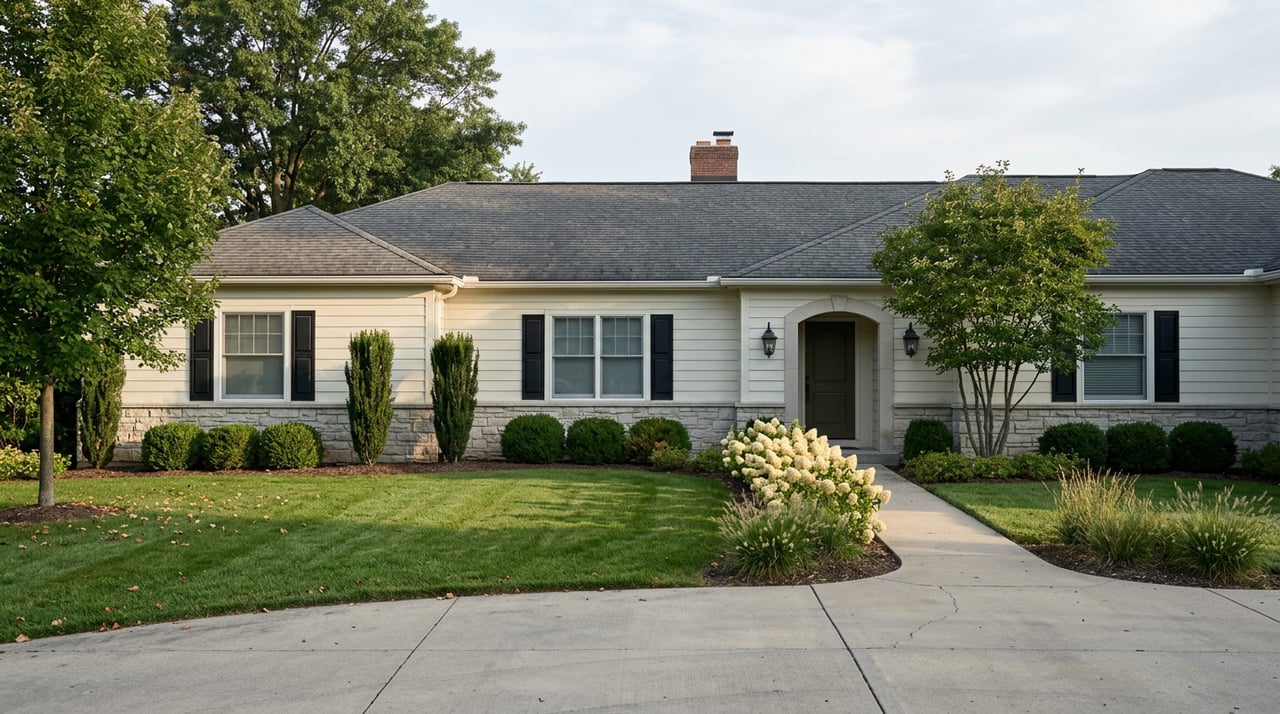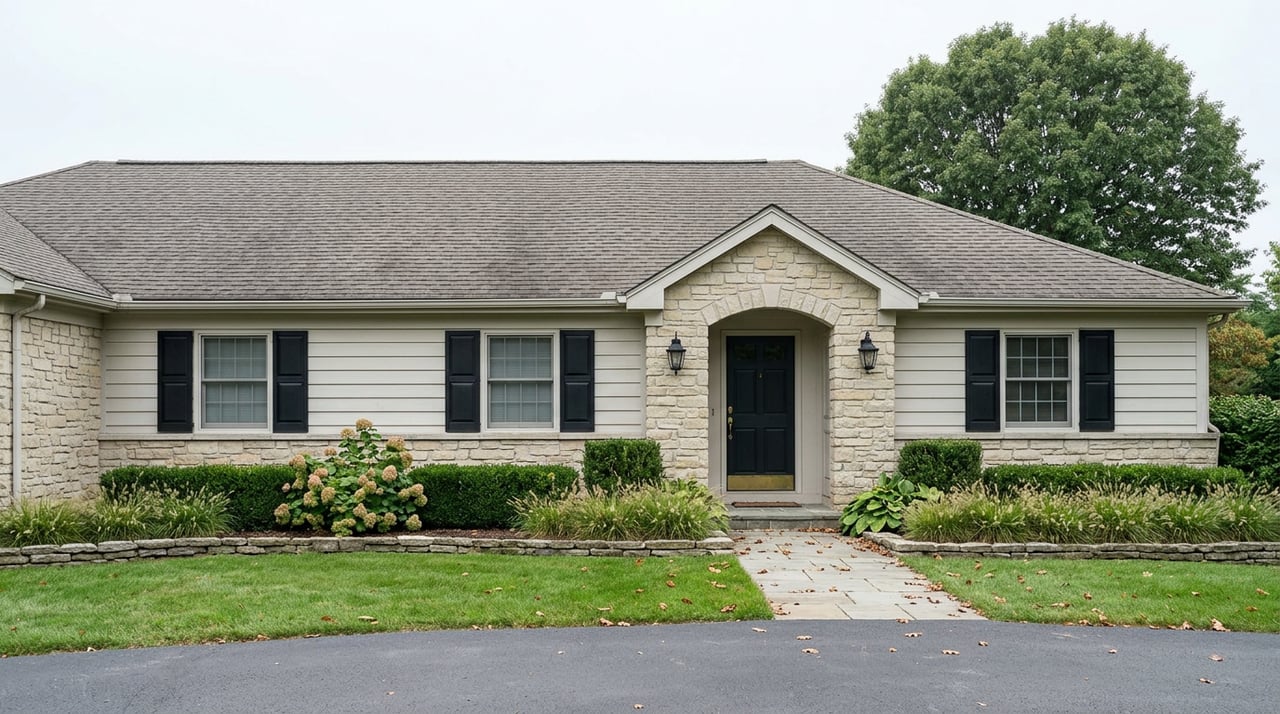
Ask anyone who has tried to downsize in Carmel without leaving the city, and you'll hear some version of the same complaint. They own a four-bedroom house in a subdivision like Bridgewater Club or Crooked Stick. The kids are gone. The house is too big, the yard is too much work, and they'd like something smaller, still in Carmel, ideally still close to the same doctors and the same grocery store. So they start looking. What they find is a two-bedroom condo downtown with less square footage than their current basement, priced at a per-square-foot rate that makes the trade feel less like downsizing and more like a different kind of expensive.
That gap isn't a fluke of one buyer's search. It's the shape of Carmel's housing stock right now, and the city's own data backs it up.
The Number Everyone Quotes, and the Number Behind It
When people talk about Carmel real estate, they usually reach for one figure: the median. In the three months ending April 2026, Carmel's citywide median sale price sat around $550,000, working out to roughly $206 per square foot. That number gets repeated on every portal and in every casual conversation about whether Carmel is "worth it."
What the median doesn't tell you is what kind of home it's describing. Carmel's Housing Task Force, convened by Mayor Sue Finkam in February 2024, spent months digging into exactly that question, and the findings are blunt. Of the city's roughly 41,500 housing units, about half have four or more bedrooms. Ownership sits at 73 percent. The report described a market with a clear surplus of larger, higher-cost single-family houses, a shortage of smaller ownership units, and too few affordable rentals to fill the gap in between. In plain terms, Carmel is very good at building large detached houses and, downtown, very good at building luxury apartments and condos. It has almost nothing sized or priced for the space between those two extremes.
That's the mechanism behind the median. It isn't one market quietly appreciating. It's two markets, moving on different tracks, averaged into a single number that describes neither one accurately.
What $500,000 Buys, Depending on Which Carmel You Mean
The clearest way to see the split is to compare the west side to the downtown core directly.
| Typical product | Recent price per square foot | What the price is actually buying | |
|---|---|---|---|
| West side (Bridgewater Club, Crooked Stick, Village of West Clay) | Detached 4 to 5 bedroom houses, often with basements | Homes with a basement averaged $731,000 in Q1 2026, against $456,450 for comparable homes without one | Land, storage, bedroom count, distance from foot traffic |
| Downtown core (City Center, Midtown, the Arts & Design District, Proscenium) | 1 to 2 bedroom condos and apartments | Carmel City Center's median sale price was $496,000 over the three months ending May 2026, at $298 per square foot, up 11.4 percent year over year | Walkability, low maintenance, proximity to the Monon Trail and the Palladium |
Notice what's missing from both rows. There's no three-bedroom townhouse at a moderate price point. There's no duplex or fourplex product that would let a downsizing homeowner trade square footage for convenience without also absorbing a per-square-foot premium of 40 to 50 percent. Downtown Carmel condo pricing more broadly runs from roughly $500,000 into the $1.5 million range depending on the building, which means the "smaller and simpler" option is frequently the more expensive option per square foot, not the cheaper one.
The one project built specifically for this in-between buyer, Overture at Proscenium, illustrates the point rather than solving it. It offers seven condos, all on the top floor, each with a private balcony, marketed directly at homeowners who want to downsize without downgrading their finishes. It's a real answer to the demand the task force documented. It's also still a luxury product at a luxury price. The market's first response to the missing middle problem has been to build a smaller version of the expensive thing, not a genuinely mid-priced alternative.
The City Already Knows This Is a Problem
Carmel isn't ignoring the gap. It's actively studying it, and the timeline matters if you're weighing a purchase in the next year or two.
The 2024 task force's recommendations included a direct instruction to facilitate missing middle housing, effective immediately, and to complete a zoning assessment in 2025. That work fed into the Mayor's Advisory Commission on Housing, which took over evaluating the recommendations in 2025. Early in 2026, the city hired urban designer Daniel Parolek, founder of Opticos Design and the person generally credited with coining the term "missing middle housing," for a study worth up to $55,000. Parolek presented his initial findings to the Advisory Commission at a public meeting on March 26, 2026, laying out where duplexes, triplexes, and courtyard-style buildings might realistically fit into the city's zoning.
The reaction has been split, and it's worth understanding before you assume any change is imminent. Some residents at that March meeting argued Carmel needs more diverse housing to keep both younger buyers and aging homeowners from being priced out of the city entirely. Others pushed back hard, including a resident letter published in April 2026 opposing the consulting spend and warning that added density would change the character of existing single-family neighborhoods. As of this writing, no zoning changes have been adopted. The city council is still reviewing recommendations and collecting public input.
Meanwhile, one piece of new supply is already moving. Buckingham Properties' redevelopment of the Gramercy apartment complex and the adjacent Carmel Marketplace retail center, between 126th Street and Carmel Drive, includes plans for 167 for-sale townhouses and 24 for-sale condominiums alongside new and renovated apartment units. Later phases of that project were slated to begin construction in 2026, which makes it one of the few concrete answers to the missing middle question currently under construction rather than under study.
What This Actually Means If You're Buying, Selling, or Trying to Downsize
If you're comparing Carmel's median price to a neighboring suburb, ask which segment of Carmel's market that median is drawing from. A number built mostly from large west-side houses tells you almost nothing about what a smaller downtown unit will cost you.
If you're trying to downsize inside Carmel, budget for a higher price per square foot downtown, not a lower one. The convenience premium at City Center and Proscenium currently runs well above the citywide average.
If you're a first-time buyer priced out of a west-side subdivision but not interested in a downtown condo, watch the Gramercy/Carmel Marketplace project and any zoning changes that come out of the 2026 missing middle study. That's where new mid-priced inventory is most likely to appear first.
If you own a large west-side house and are weighing whether to list now or wait, the basement-versus-no-basement price gap documented in Q1 2026 (roughly $731,000 versus $456,450) shows how much a single structural feature is currently worth to buyers. That's a useful data point for pricing conversations, whichever side of that gap your home falls on.
A few questions this raises
Is Carmel about to get a wave of new duplexes and townhouses? Not immediately. The Parolek study is a recommendation, not an approved zoning change, and the city council has not set a final decision date as of this writing.
Does the downtown price premium mean condos are a bad value? Not necessarily. You're paying for walkability to the Monon Trail, the Palladium, and City Center rather than for square footage. Whether that trade makes sense depends entirely on what you actually want out of the next home.
Where should I look if I want something between a subdivision house and a downtown condo? Right now, the Gramercy/Carmel Marketplace redevelopment is the clearest concrete example of that middle product under construction. Beyond that, it depends on how the city's zoning study plays out over the next year.
If you're trying to figure out whether Carmel's split market works for your plans or against them, The Molife Group can walk through the actual inventory with you instead of the median. Whether that means pricing a west-side house that's grown too big, evaluating a downtown condo against its real per-square-foot cost, or simply deciding whether now is the right moment to make a move, get your no-obligation offer and a straight answer about where your specific situation fits into this market.